The King's Fund Annual Annual Conference 27th November 2019
Sophie Chester-Glyn • 29 November 2019
The King’s Fund is a leading think-tank and independent charity which holds regular health and social care event and shares research and commentary. Whilst the King’s Fund has traditionally focused on health-related topics, it is increasingly shining the light on aspects relating to social care. This is a summary of some of the talks from the first day of its two-day annual conference held in London on 27th November 2019.
This was Coproduce Care’s first time attending an annual conference held by The King’s Fund
and the line-up of speakers was impressive. The morning’s breakfast session included Richard Sloggett(Former Policy Advisor for Matt Hancock), Lesley Regan(President of the Royal College of Obstetricians), Ben Jupp(Director of Policy Social Finance) and Natalie Bohm(Senior Medical Affairs from Pfizer UK). The session’s focus was on delivering population health. Richard pointed out that prevention in government is difficult and siloed and that the system lacks patient centricity. Integrated care systems on the other had will move towards a person-centred approach, as the delivery of population health cannot be delivered solely through an NHS lens.
Improving Health Locally
Nick Timmins from the Kings Fund
kicked off the next session introducing his new report on ‘Leading for integrated care’ which has the apt subtitle of:
‘if you think competition is hard you should try collaboration’

What does it all mean?!
The panel for this first session went on to explain their tips for leading across complex health and care systems. However, a member of the audience asked a prevalent question: ‘what’s an SHA?’ she asked, ‘can you all please stop using acronyms and I don’t know what you mean’. Unfortunately for her, however the conference was full of acronyms which no one really stopped to explain.
The importance of language in effecting behaviours was pointed out by Owen Williams(Chief Executive of Calderdale and Huddersfield NHS Foundation Trust) who mentioned that within his organisation he decided not to use the work Integrated Care System(ICS) but instead used ‘partnerships’ as that was effectively what they were creating. He explained that organisations should refrain from waiting for central government policy or action and start affecting better collaboration as well as change locally to benefit their populations. Concerns about ‘BME representation’ were also high on Owen’s list, arguing that conversations around representation should happen more frequently.

Professor Paul Burstow(Independent Chair at Herefordshire and West Essex Sustainable Transformation Partnership) pointed out that, when working within integrated systems, people should consider whether they are going to ‘change the rules or play by the rules’
and that the challenge is often that people embarking on integrated systems often want to know the end result so that they can work towards it. However, this is often very difficult to certify when the change is developed corproductively.

According to Paul, what would be helpful is a better conversation between local government and NHS on funding.
Paul Burstow had some final quick-fire tips:
- On Talent: if health and care organisations are thinking of how you are working as an integrated system, the talent within your organisation should be the bridge builders to move things forward.
- On Priorities: don’t have too many!
- On Governance: within his organisation they are constructing a new governance in working in NHS or as a multi-sector partnership rather than within an NHS construct. The concept of ‘looking up’ is key.
- On Challenges: expecting people to effect integration within the day job, is a tough ask and is very difficult – a theme which came up a lot during the day.
- On Recruitment: – Paul’s team is looking for a new leader! …….. #Spreadtheword.
Breakout sessions – the role of social care in prevention
This session didn’t specifically focus on traditional forms of social care but was more focused on community support. The session was chaired by The King’s Fund’s Simon Bottery
and included representations from Social Care Institute for Excellence(SCIE) and The Chartered Institute for Public Finance and Accountancy(CIPFA).

From a finance perspective, Dr Eleanor Roy(from CIPFA) pointed out that over half of most local authorise budgets are spent on social care and that the barriers to prevention were a lack of long term commitment which lasts longer than a term in government. In comparison to health, social care faces a higher bar for preventative outcomes and that there is often a push for cash incentives.

Find out more here: https://www.wyhpartnership.co.uk/application/files/3215/5428/0490/Loneliness_case_study.pdf
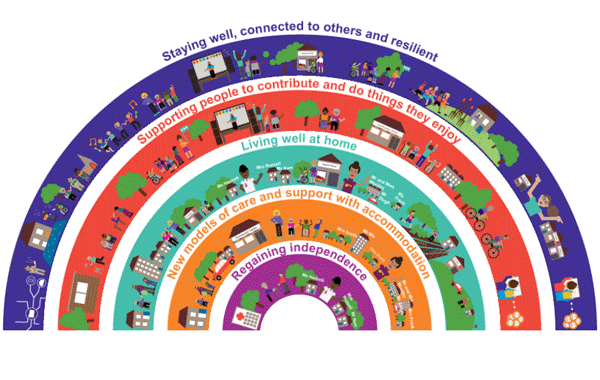
Ewan King(Chief Operating Officer for SCIE) discussed SCIE’s work with Think Local Act Personal and mapping the fantastic innovation carried out by community groups as represented on their community-centred support directory resource (see below and access online here). The aim is to create a resource whereby Commissioners can find out about new and innovative approaches to care and support for adults and providers and people with lived experience can see what’s going on locally and nationally.
Ewan explained how organisations such as the Red Cross, Key Ring
and Cares family
have already interacted with the directory and are sharing great practice by tackling isolation, making savings helping people to achieve their goals.
What we felt was a lesser known but very interesting part of Ewan’s talk was SCIE’s Social Care Innovation Network. Ewan explained that this aims to find out what works and what people need to do when ensuring integration happens. Well worth a look.
We asked the question at the end of the session of:
“what is the definition of social care?”
Apparently, this is too big a question and needs a whole session to answer it! Give us your comments…..maybe this should be a topic for a ‘Coproduce Care Chat’ for YouTube??
Manifesto – Which Party for Health and Social Care?
If you find this brief summary on election manifestos lacklustre - Never fear, the Kings fund is doing two great things over the coming days:
- Releasing a podcast to discuss the manifestos
- Releasing a manifesto grid to help voters navigate the health and social care manifesto quagmire (yippee!).
Inequalities in health and care
The last session, before a well-deserved drinks reception, included a mind-blowing talk from Professor David R Williams(Professor of Public Health and Chair Department of Social and Behavioural Sciences, Harvard University). We’ve heard from Professor Williams before at the NHS Confed
and much of his talk similarly centred around detailing emotive facts and effects of inequality.
Professor Williams reminded us of:
- the experiences of discrimination are a source of toxic stressed suffered by marginalised groups in health and social care workforce
- people dying young because of societal inequalities and access to services
- the resultant high numbers of infant mortality and postnatal depression
- the effects of institutional racism.

Another organisation used electronic inhalers to monitor when and where people used their medication to identify geographical hotspots and crowdsourced innovations so that trucks were re-routed, trees planted and areas targeted for high pollution.
For more on Professor Williams: https://www.hsph.harvard.edu/david-williams/
Another great conferences, packed with information. Hope our brief summary has given you a flavour!
#staytuned #share #CoproduceCare #blogs #democratise the #caredebate
This Facebook widget is no longer supported.
Join us
We will be relying on a small but dedicated team and volunteers.
So, if you would like to be involved, please get in touch at hi@coproducecare.com
and help us open up the care debate, properly democratise care and please do join and share Coproduce Care:
Spread the word and uncover the hidden opportunities for people-led coproduced care